

December 7: Saint Ambrose, Bishop and Doctor of the Church

A spiritual and civic guide
Dedicated to intense pastoral activity, without neglecting his constant study of Scripture - this is Saint Ambrose, born in 339 in Trier, into a Roman family already deeply rooted in the Christian faith; his father at the time held the prestigious post of Prefect of the Praetorium of Gaul.
Upon his father’s death, the family returned to Rome, where the young Ambrose completed his legal and rhetorical education. Thanks to his abilities, he entered the imperial administration: first as a lawyer at the praetorian prefecture of Sirmium (in present-day Bosnia), then as consularis of the Emilia-Liguria region, governed from Milan.
When the Arian bishop Auxentius died, the city was shaken by tensions between Catholics and Arians. Ambrose, attempting to restore calm, presented himself in a church and delivered a speech inviting concord. It was then that, suddenly, a child cried out his name, proclaiming him Bishop. That simple call was immediately echoed by the crowd, which turned it into a unanimous request. After a moment of surprise and hesitation, Ambrose recognized in that collective voice the will of God. Although he was still a catechumen, within just one week he received baptism, was instructed by the presbyter Simplician, and finally received episcopal ordination on December 7, 374, despite his reluctance.
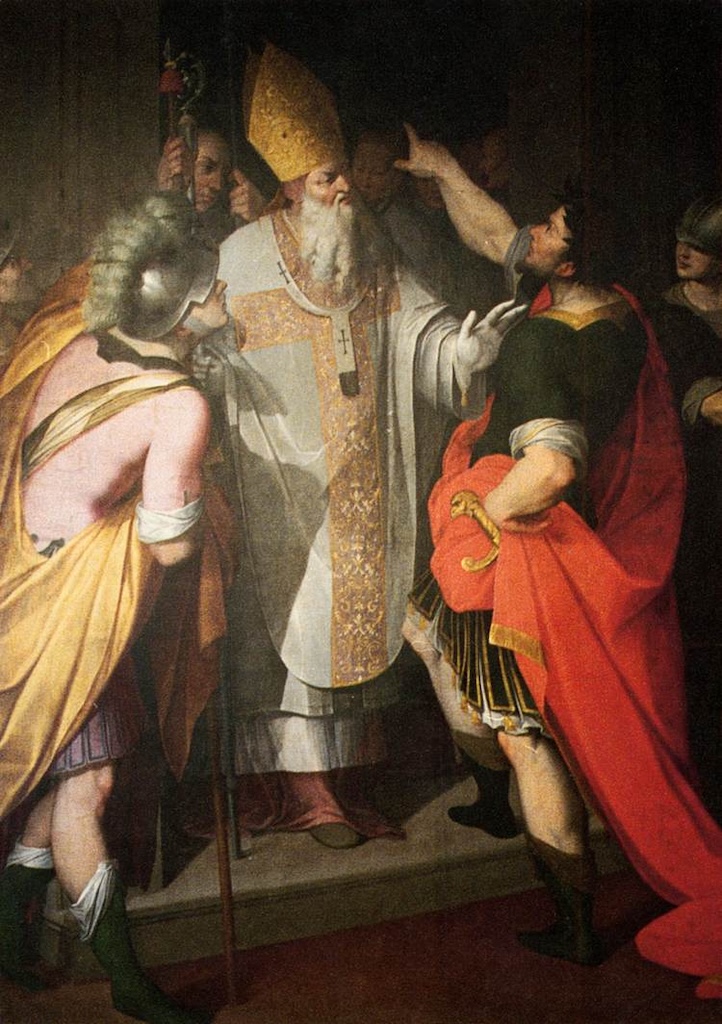
The new office was demanding, but Ambrose devoted himself to it with astonishing speed. He dedicated himself to an in-depth study of the Bible and Christian writers, quickly becoming a spiritual guide. Thanks to his personal authority, he became an adviser to various emperors — Gratian, Valentinian II in Sirmium, and finally Theodosius I — though he did not hesitate to oppose Empress Justina, a supporter of Arianism. His stern confrontation with Theodosius also became famous: in 390, after the emperor had ordered a bloody repression in Thessalonica, Ambrose denied him entry into the church until he performed public penance, thus reaffirming the independence of the Church from political power.
His ministry, however, was distinguished above all by his charity, his reform of the liturgy — from him the Ambrosian rite took shape — and his spiritual formation of souls; especially renowned was his decisive influence on Saint Augustine. His works, ranging from theology to exegesis, from moral teaching to liturgy, led to his being recognized as one of the first four Doctors of the Church alongside Augustine, Jerome, and Gregory the Great. He died on April 4, 397, Holy Saturday.